Sep 28, 2020 • Filed to: Answer Hard Drive Problems • Proven solutions
There are many types of applications for all kinds of needs and they are very easy to install thanks to the dynamic and intuitive design of macOS. With just a couple of clicks, the application will be ready to use, however, the applications are not very different from the rest of the programs/software since these work in a very similar way and for this reason, they can also fail, fortunately, These problems have a solution, the information that the application's host is recoverable in case your application has failed or even if you have accidentally deleted it.
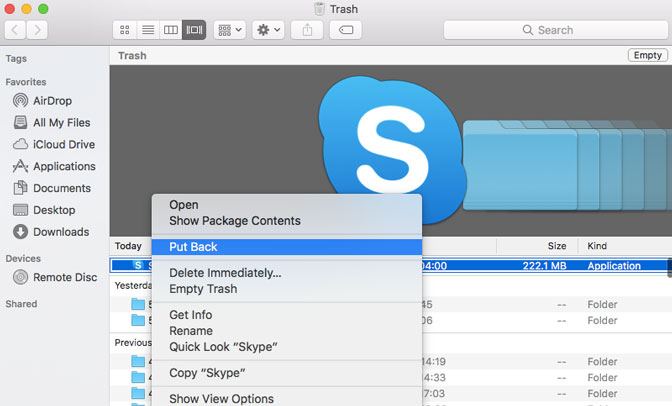
Part 3: The Common Methods to Restore Deleted Apps on Your Mac. Restore from 'Trash' When you delete an application, it is always sent to the 'Trash' app, from this, you can restore your application and this is the easiest way to do it. Step 1: Click on 'Trash' icon, which is at the lower right corner in the Dock.

Part 1: How to Recover Deleted Apps?
Q: I deleted an application by mistake. Is there a way to recover it from my Mac Hard Disk Drive?
Daily Mac users depend on applications to perform their daily tasks. Applications can be deleted when they are no longer considered useful, but also by mistake or even by errors in the system (sometimes generated by automatic updates) and this can cause the information stored within the installation folder to be deleted, but neglect, the information deleted from your applications is recoverable and you can also prevent this type of problem from arising in the future by taking some precautionary measures.
Part 2: How Apps Get Deleted from Mac Hard Drive?
Generally, applications on Mac computers are removed using Launchpad or the Finder application, however, applications can also be removed unexpectedly due to some reasons. These are
- Application Folder Deletion: On many occasions, users decide to delete applications when they want to clean the computer, since there are many folders that they consider will not be necessary for the future or sometimes, users notice that there are folders whose name does not correspond to any known application and therefore they confuse them with something that was installed or saved by mistake. If for any reason you delete those folders, therefore, the information will be deleted too and you will not be able to access it.
- Unplanned System Format: If for some reason your hard drive suffers damage (either physical or by corrupted information), it is common that you have to format the drive to correct those errors. This process causes all the content that is inside your disk to be deleted automatically, therefore, it is advisable to make backups on another disk or some removable storage drive before formatting your drive to later transfer the information back into your main disk.
- Failed Application Update: Applications need to be constantly updated to work properly. Over time, if you do not update them, they may remain in an out-dated version and therefore do not have technical support, which can result in incompatibility problems, instability, lack of efficiency in tasks, and loss of information.
- Replacing Existing App with Other: In many cases, some applications can replace without any problem those we use because they have more functions, uses less space on the hard disk, have better compatibility with the operating system, or simply because you had a bad experience with an application and you want to try with a new one. In some cases, the new application's information folders are likely replaced by a new one, and this implies the loss of all the information that you have not backed up or stored in a separate folder. Therefore, although replacing one application with another is a simple task, you should consider saving all the information that has been created with the application you want to delete in a separate folder so that in this way you can use it in the future with another application that is compatible with its format
- macOS Reinstallation: Any operating system (including macOS) may have errors that need to be corrected and the most convenient and pertinent solution is through the reinstallation of the operating system. However, this can be counterproductive if you don't save your important information on another storage device, as this process removes your information and applications.
Part 3: The Common Methods to Restore Deleted Apps on Your Mac
- Restore from 'Trash'
When you delete an application, it is always sent to the 'Trash' app, from this, you can restore your application and this is the easiest way to do it.
Step 1: Click on 'Trash' icon, which is at the lower right corner in the Dock
This will let you open the 'Trash' application, which is the one that keeps the files and applications that you have deleted.
Step 2: Search for the application you want to restore
You can search it manually in the list of the 'Trash' application or you can type its name in the search bar.
Step 3: Right-click on its icon and select 'Put back' in the drop-down list
After that, a pop-up window will be shown.
Step 4: Sign in to your Apple ID account
If you haven't signed into your account, you will be asked to do it. Just write your username and password of your Apple ID account and then click on 'OK' to sign in. After you finish, the deleted app will get back to its original location.
- Restore from App Store
If you have deleted an application but you previously purchase it, you can download it again from App Store.
Step 1: Open 'App Store'
Open this application to access all the applications that you have installed.
Step 2: Click in your name in the lower-left corner of the window
Now you can see all the applications you have installed, including the ones that you have deleted. You can realize which you have uninstalled because under their names they have a blue cloud icon.
Step 3: Click on the blue cloud icon to download your deleted application
The installation will start immediately and once the process has finished you will be able to use the application.
- Restore from Installation CD
You can reinstall an application if you have its CD or DVD.
Step 1: Insert the CD and install
Insert the CD in the CD drive. An installation menu will be shown, depending on the application, some options can be displayed. Just select the options that fit in your needs and then install them.
Restore Deleted Apps On Kindle Fire
- Restore from iTunes or iCloud
Although iTunes is principally used to download and manage music files, there is a way to retrieve deleted apps in a specific section.
Step 1: Open 'iTunes'
Accidentally Deleted Iphoto App On Mac
Open 'iTunes' to access all of your personal information.
Step 2: Click on 'iTunes Store' tag
This will let you enter the store section of 'iTunes'.
Step 3: Open 'Purchased' apps menu
Click on 'Purchased' to open the section of your purchased files and applications.
Step 4: Open 'Apps' section
Click on 'Apps' and 'Not in My Library' tags.
Step 5: Search for the application you want to restore
Choose the application you want to reinstall and click on the white cloud icon which is at the upper right corner of the icon. The installation will start automatically and then you will be able to open it again.
Part 4: Sure Shot Solution: Restore Deleted Apps
Although the four ways to recover deleted apps are useful and can indeed restore your applications, it is not certain that you will get back all of the saved files, this means that you can use again the application with all of its features, but sometimes the deleted files not necessarily will be put back. This depends exclusively on the software, so sometimes it can be a coin toss if you will recover your data.
Restore Deleted Files Windows 10
There is a way where you can retrieve deleted apps and all of the information linked to them through simple, fast, and trustworthy software which is Recoverit Data Recovery for Mac. You can download it in this link.
Next, I will show you how to recover your deleted apps information.
Step 1: Select the Drive
To recover any lost or deleted file from a drive, you should choose it as the target location for data scanning and searching.
Step 2: Scan the Drive
An all-around scan starts once you make the choice. It usually takes a few minutes.
During the process, you can filter and locate files of your choice.
Step 3: Preview and recover files
After it, Recoverit provides the preview function for you before recovery. A variety of files can be previewed, such as pictures, videos, movies, audios, music, documents, and so forth. Then, select one or more files you want to restore and click 'Recover' to get all of them back.
Conclusion
Delete apps in macOS is one of the most practical and efficient ways to free space and keep the information organized. Users usually uninstall applications that are not required at the time and it is understandable. However, when it is needed to retrieve data from those apps, the process can be complex because not always the files are restored and this can be big trouble if you don't have any backup of your information. Fortunately, Recoverit will let you access to all the files you lost after deleting any application in just a couple of minutes. Recoverit will restore the deleted information and also will repair any damaged file.
What's Wrong with Drive
- Recover Your Drive
- Fix Your Drive
- Format/Wipe Drive
- Know Your Drive
Losing your important and sensitive data is devastating. Moreover, when we intentionally or unintentionally end up deleting a folder that we didn’t mean to delete is not less than a nightmare. Even worse, if you have a due date approaching to submit your project that you have been working from past few days make the situation more frustrating. Fortunately, if you performed the steps carefully then you can retrieve deleted files.
So, let’s discuss ways to recover permanently deleted files (photos, videos, docs etc.) on Mac using undo your action, trash can, time machine, and data recovery software. So, let’s get started!
Recover Permanently Deleted Files On Mac Without Software

Method 1: Restore Deleted Files on Mac Undo Your Action
In case, you have recently deleted your vital files and want to retrieve deleted files on Mac then you can undo your action to get your prior positions. However, do the same there are certain conditions like it has to the most recent thing is you have done from Finder by dragging and dropping the files/folders. Then you will notice you will get a small window at the bottom-left corner of your screen which says Undo Move, you can click on it to get the previous files back. You can also press Command + Z to get to the previous positions.
Method 2: Recover Deleted Photos on Mac Using Trash Can
If you want to recover deleted photos on Mac or want to learn the simplest way to retrieve deleted files Mac, then learn here how to recover deleted files from Mac.
Step 1: Access your Trash Can app by double-clicking on it. You can use spotlight search to open the Trash can or you can manually open it from the Docks.
Step 2: Now, you need to navigate the files that you have accidentally deleted and want to retrieve deleted files from your Mac. You can use the search box to locate the files and folder you’re looking for.
Note: If you’re not able to locate your deleted folders then you need with a shot with Time Machine to recover permanently deleted files on Mac.
Step 3: Choose your deleted files/folders. Press Command + A to restore deleted files on Mac. You can also recover permanently deleted files one by one selecting them individually.
Step 4: Choose Files located next to Finder and then click on Put Back from the available options.
Step 5: Now, all the selected files will be available at its original location.
Step 6: In case, Put Back option is unavailable or greyed out, then you can retrieve deleted files from Mac by selecting and dragging the files from Trash to desktop or desired folder.
Note: You need to drop the files when you’re in the preferred folders where you want to keep your photos.
Method 3: How to Retrieve Deleted Music Files in iTunes
Step 1: Open iTunes and go to Preferences.
Step 2: Choose Advanced tab.
Step 3: Put a checkmark beside ‘Copy files to iTunes Media folder when adding to library’.
Step 4: Now, you can close Preferences.
Step 5: Now, you can select and drag all the files to Desktop from the Trash.
Step 6. You need to drag the music files onto iTunes’ icon in the Dock.
Step 7: Once the files are imported, you need to drag the music files from the Desktop to Trash
Step 8: You will notice a copy of the content has been added to your iTunes folder.
Method 4: How to Recover Deleted Files on Mac via Time Machine?
It is one of the easiest and quickest way to recover deleted files on Mac via Time Machine which is the default app that comes with each Mac. Follow the below mentioned steps to restore your deleted files.
Step 1: First, you need to access spotlight which looks like to a small magnifying glass icon located at the upper right corner of the screen.
Step 2: You need to type down time machine in the Spotlight search tab. You can also access Time Machine from Finder and then Application folder.
Step 3: When you are in the Time Machine, you need to locate the files that you are interested in recovering.
Note: If you’re not able to locate your files then you can select the folders one by one which is located at the left -pane of the Time Machine to investigate the content each folder has.
Step 4: You need to click on the upward arrow which is located at the upper side of the Time Machine window you need to scroll across the backups till you notice your deleted items displayed.
Step 5: In case, you’re scrolling the pervious files with their creation dates and not able to locate them then you can use go with the Time Machine to restore the files.
Recover Permanently Deleted Files On Mac With Software
Using the Stellar Mac Data Recovery
You can also use any of the data recovery tools to restore permanently deleted files on Mac. It is another way to retrieve permanently lost files (photos, documents, videos) without trouble. Apart from recovering deleted photos on Mac, this tool comes handy forget the simultaneous preview of photos while scanning. It is an amazing tool that can be accessed in a few minutes to get your deleted photos and files in no time.
Overall, these were some of the effective ways to recover permanently deleted files on Mac in real time. If you face issues while performing the above-mentioned steps or an error occurs during the recovering process, then let us know in the below comments box.